Video Hub
Orthodontics, explained in a couple of minutes
Short, straight-talking videos from our specialist orthodontists — answering the questions patients ask most, alongside real stories from people we've treated across West Yorkshire.
Thinking About Treatment?
Start here. Short answers to the questions patients ask before booking a consultation.
Watch
What's the difference between a dentist and an orthodontist?
Every orthodontist is a dentist, but not every dentist is an orthodontist. In this short clip the team at The Brace Place explains the difference. A dentist looks after your overall oral health — check-ups, fillings, hygiene and general treatment. An orthodontist is a dentist who has completed several additional years of specialist university training focused entirely on the alignment of teeth and jaws, and is registered with the General Dental Council on the specialist orthodontic list. That extra training matters when you're moving teeth. A specialist orthodontist plans your treatment around the long-term health and stability of your bite, not just how your teeth look at the end. It's why complex cases, growth in children, and treatments like Invisalign and fixed braces are best handled by someone who does orthodontics every day. At The Brace Place, every case is led by a specialist orthodontist, so you can be confident the person planning your smile has the qualifications and experience to do it properly.
- All orthodontists are dentists, but they've done years of extra specialist training
- Specialist orthodontists are registered on the GDC specialist list
- Every case at The Brace Place is led by a specialist orthodontist
Watch
NHS vs private orthodontic treatment
Wondering whether to go NHS or private for braces? This short explains the practical differences. NHS orthodontic treatment is available to under-18s who meet a clinical need threshold (the IOTN scoring system), and where places are limited there can be long waiting lists. NHS treatment also focuses on function rather than choice — you generally can't pick your appliance, and options like Invisalign or tooth-coloured ceramic braces aren't part of it. Private treatment removes the waiting list, opens up the full range of appliances including clear aligners and ceramic braces, and is available to adults as well as children. It also means more flexible appointment times and a treatment plan built around what you want from your smile. At The Brace Place we offer 0% finance to spread the cost, which makes private orthodontics far more accessible than many people expect. The right choice depends on age, eligibility and how much say you want over your treatment — and a free consultation is the quickest way to find out where you stand.
- NHS braces are for under-18s who meet a clinical need score, often with waiting lists
- Private treatment has no waiting list and offers Invisalign and ceramic options
- 0% finance makes spreading the cost of private treatment straightforward
Watch
'Turkey teeth' — why we don't recommend it
"Turkey teeth" has become shorthand for cut-price cosmetic dentistry abroad, where healthy teeth are aggressively filed down to pegs and capped with crowns or veneers for a quick, uniform smile. In this clip our team explains why that trend worries orthodontists. Filing down healthy enamel is irreversible — once it's gone, those teeth will need crowns for life, with the ongoing cost, maintenance and risk of nerve damage or infection that comes with it. Orthodontics offers a fundamentally different approach: braces and clear aligners move your own natural teeth into a better position without destroying tooth structure. The result is a straight, healthy smile built on the teeth you already have, planned and monitored by a specialist. If your goal is a confident smile, the safest route is almost always to straighten what you have rather than grind it away. Book a consultation and we'll talk you through the options that protect your teeth for the long term.
- 'Turkey teeth' means filing down healthy teeth for crowns — and it's irreversible
- Orthodontics moves your natural teeth instead of destroying them
- A specialist-planned smile protects your long-term oral health
Invisalign & Clear Aligners
How Invisalign works and what to expect from clear aligner treatment for teens and adults.
Watch
Invisalign for teens
Invisalign isn't just for adults — it's a popular choice for teenagers too. This short looks at why clear aligners work so well for younger patients. Invisalign aligners are virtually invisible, so teens can straighten their teeth without the self-consciousness that can come with a mouth full of metal — ideal for school photos, sport and social confidence. Because the aligners are removable, there's no change to diet and brushing and flossing stay simple, which helps protect against decay and white marks during treatment. Invisalign for teens includes clever features such as compliance indicators that fade with wear, so parents and the orthodontist can check the aligners are being worn for the recommended 20–22 hours a day. As with any Invisalign treatment, results depend on wearing them consistently — but for motivated teenagers the comfort and discretion make that far easier. At The Brace Place our specialists will assess whether Invisalign is the right fit for your teen, or whether another option would work better.
- Clear aligners are virtually invisible — great for teenage confidence
- Removable aligners mean no diet changes and easier cleaning
- Compliance indicators help parents and orthodontists track wear
Watch
Emma's Invisalign journey
Meet Emma, one of our Invisalign patients, sharing her experience of clear aligner treatment at The Brace Place. In this short Emma talks through what the journey was actually like day to day — from her first digital scan and seeing a preview of her final smile, through wearing the aligners and swapping to a new set every couple of weeks, to the confidence she feels in her results. Hearing directly from a patient answers the questions consultations often can't: how it feels to wear aligners, how they fit around everyday life, and whether the effort was worth it. Emma's story is a good example of what Invisalign can achieve for an adult who wants a discreet, low-fuss way to straighten their teeth. If Emma's experience sounds like the smile you're after, our Invisalign specialists can assess your teeth and show you what's possible.
- A real patient's account of Invisalign from scan to finished smile
- Shows how aligners fit around everyday adult life
- Discreet treatment with results worth the commitment
Fixed Braces
What happens when braces go on, and real results from our fixed brace patients.
Watch
How do we fit braces?
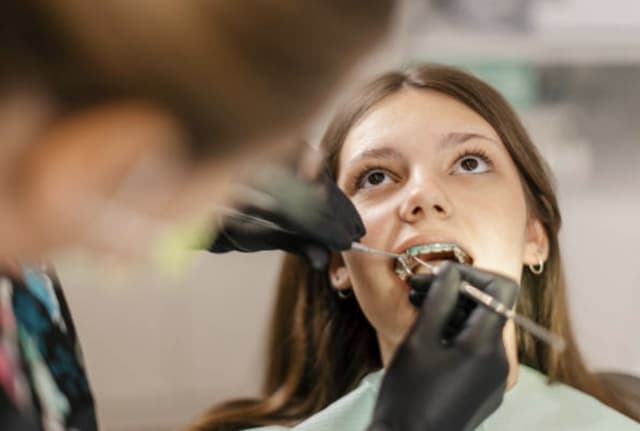
Nervous about getting braces fitted? This quick clip shows exactly what happens at the appointment — and reassures you that it's far more comfortable than most people expect. Fitting fixed braces is completely painless: there are no injections and no drilling. We start by gently cleaning and preparing the surface of each tooth, then bond a small bracket to the front of every tooth using a special dental adhesive. Once the brackets are in place, a thin archwire is threaded through them and secured, and it's this wire that does the gentle work of guiding your teeth into position over the coming months. The whole process typically takes around an hour, and you leave the same day with your braces on. It's normal for teeth to feel a little tender for a few days afterwards as they start to move, but the fitting itself is straightforward and stress-free. Knowing what to expect takes the worry out of day one.
- Fitting braces is painless — no injections and no drilling
- Brackets are bonded to each tooth, then joined by a gentle archwire
- The appointment takes about an hour and you leave with braces on
Watch
Molly's fixed braces result
Molly chose fixed braces at The Brace Place, and in this short she shares how the treatment went and how she feels about her new smile. Fixed metal braces remain one of the most effective, reliable and affordable ways to treat a wide range of orthodontic problems — from crowding and gaps to more complex bite issues that clear aligners can't always tackle. Molly's story shows the human side of that: the small adjustments along the way, the support from the team, and the confidence that comes with the finished result. Patient stories like Molly's are one of the best ways to picture your own journey, because they show real teeth, real timescales and a real reaction to the outcome. If you're weighing up fixed braces, seeing what they achieved for Molly is a great place to start — and a free consultation will tell you what they could achieve for you.
- A real fixed-braces result from a Brace Place patient
- Fixed metal braces are effective, reliable and affordable
- Great for crowding, gaps and more complex bite problems
Children's Orthodontics
Early treatment, growth appliances and what orthodontics looks like for younger patients.
Watch
Different orthodontic appliances explained
Orthodontics is about much more than a set of train-track braces. In this short we run through some of the different appliances we use — and why the right one depends entirely on the patient. Fixed braces move teeth precisely and suit the majority of cases. Removable appliances and functional appliances such as twin blocks are often used in younger, growing patients to guide the development of the jaws and correct the bite while there's still growth to work with. Expanders can gently widen a narrow upper jaw to create space and improve how the teeth meet. Clear aligners like Invisalign offer a discreet, removable option for suitable cases. Each appliance does a specific job, and part of a specialist orthodontist's role is choosing the combination that will give the best, most stable result for that individual. If you're curious which approach might suit you or your child, a consultation is the best way to find out.
- There are many appliances beyond standard fixed braces
- Functional appliances and expanders guide growth in younger patients
- A specialist chooses the right appliance for each individual case
Watch
Early orthodontic treatment — Jude, age 9
Meet Jude, who started early orthodontic treatment with us at just 9 years old. This short explains why some children benefit from being seen young. Early, or interceptive, treatment takes advantage of a child's natural growth to address problems that are much harder to correct later — things like a narrow jaw, a developing crossbite, or teeth that are severely crowded or protruding. It doesn't always mean braces straight away; often it's a shorter first phase using a growth appliance to create space or guide the jaws, setting things up for a simpler main phase of treatment when more adult teeth have come through. The British Orthodontic Society recommends children have an orthodontic assessment by around age 7 so anything worth watching can be picked up early. Jude's story shows how positive that early start can be. If you have concerns about your child's teeth or bite, an early check-up costs nothing and gives you peace of mind.
- Early treatment uses natural growth to fix problems that are harder to correct later
- Children are best assessed by around age 7
- An early first phase can make later treatment simpler
Patient Stories
Real patients from across West Yorkshire sharing their experience at The Brace Place.
Watch
Olivia's story
In this short, Olivia shares her experience of orthodontic treatment at The Brace Place — from her first visit through to the finished result. Patient interviews like Olivia's give you an honest, unscripted sense of what treatment is really like: how the team looked after her, what the appointments involved, and how she feels about her smile now it's done. For anyone deciding whether to start treatment, hearing from someone who has been through it often answers the questions that matter most. Olivia is one of thousands of patients we've treated from across West Yorkshire, and her story reflects the friendly, specialist-led care we aim to give everyone who walks through the door. If her experience resonates with you, the next step is simply a free, no-obligation consultation.
- An honest, first-hand account of treatment at The Brace Place
- Insight into the appointments and the team's care
- One of thousands of happy West Yorkshire patients
Watch
Imaad's testimonial
Imaad talks through his orthodontic journey at The Brace Place in this short testimonial. He shares what led him to seek treatment, how he found the experience of wearing braces, and the difference the finished result has made to his confidence. Testimonials like Imaad's are valuable because they come straight from the patient — no sales pitch, just a genuine account of what it's like to be treated with us. They're especially useful if you're feeling unsure or a little nervous about starting, because they show that the process is manageable and the outcome is worth it. Imaad's experience is a great example of the results a specialist-led team can deliver. If you'd like the same, book a free consultation and we'll talk you through your options with no pressure.
- A genuine patient testimonial, straight from the source
- Reassurance for anyone nervous about starting treatment
- Shows the confidence a finished result can bring
Ready to start?
See if treatment is right for you
Book a free, no-obligation consultation with a specialist orthodontist and we'll talk you through your options.
Book a Free ConsultationAt The Brace Place we endevour to create an environment where you feel relaxed and comfortable during your orthodontic treatment.
Opening Hours
Monday to Thursday
8.00am - 8.00pm
Friday
9.00am - 5.00pm